Working Memory: Holding Patterns in Mind
The Rhythm of Remembering
Picture this: you’re halfway through a row of knitting, counting stitches under your breath, “twenty-three, twenty-four, twenty-five.” The pattern changes soon, but your mind stays focused, balancing the rhythm of your hands with the numbers in your head.
That quiet concentration is a perfect example of working memory in action. It’s the mental workspace that lets you hold and manipulate information long enough to complete complex tasks. And just like the muscles in your hands strengthen through repetition, your working memory grows sharper through creative practice.
Understanding Working Memory
Working memory is one of the core components of executive functioning. It allows us to:
Retain information temporarily (like remembering the next step in a pattern)
Update that information as we go (adjusting when we make an error)
Use it to guide behavior toward a goal (finishing a project successfully)
In neuroscience, working memory is closely associated with activity in the prefrontal cortex and the parietal lobes. These regions are involved in attention, problem-solving, and decision-making. When we engage in activities that challenge this system, such as learning a new stitch pattern or following multi-step crafting instructions, we’re effectively giving our brains a cognitive workout.
Crafting as Cognitive Training
Creative activities are an accessible, enjoyable way to strengthen working memory because they naturally blend attention, recall, and flexibility.
When knitting or crocheting, you might:
Memorize pattern repeats while maintaining even tension
Switch between written and visual cues
Adapt to a mistake without losing your place
Visualize the next steps as you work through a complex sequence
These moments of coordination between what you see, what you remember, and what you do are powerful exercises in mental organization. Every row you complete while recalling a stitch sequence helps refine your ability to hold multiple pieces of information simultaneously. One of the core demands of working memory.
The Science of Repetition and Recall
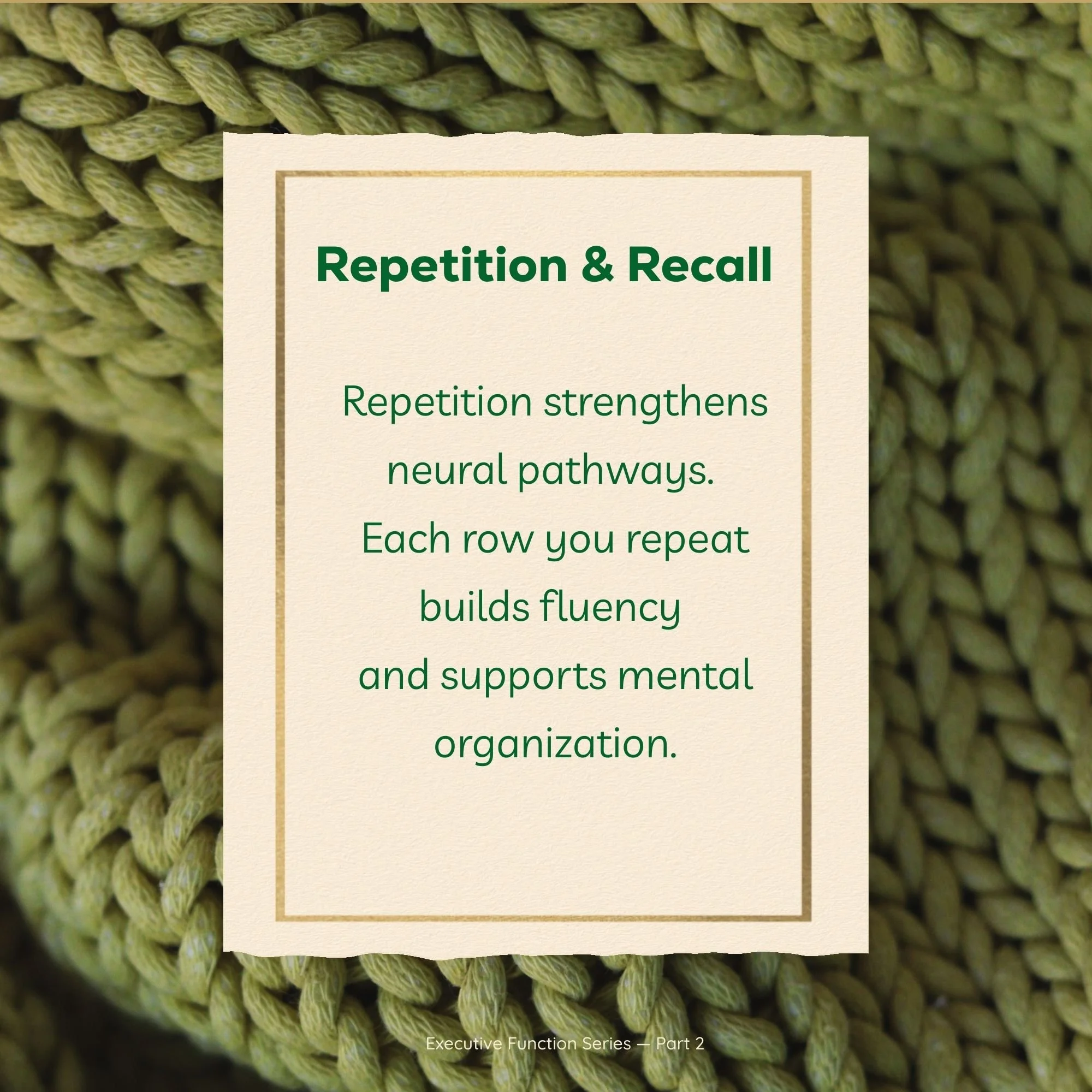
Research in cognitive psychology and behavioral neuroscience shows that repetition strengthens neural pathways related to working memory. When you engage in repeated sequences of behavior, especially when they’re meaningful or rewarding, the brain becomes more efficient at managing information across time.
In behavior-analytic terms, this is an elegant example of fluency building: through consistent practice, a task transitions from effortful to automatic. Whether it’s stitches, brush strokes, or musical notes, the more you engage in mindful repetition, the more your brain refines the neural circuits that support short-term storage and retrieval.
Creativity and Cognitive Balance
Working memory also interacts with emotional regulation. When your hands are busy and your focus narrows, you create a state of mindful awareness that quiets background noise. The tactile and rhythmic nature of crafting offers a gentle structure for managing cognitive load. You are balancing effort with relaxation.
In moments of stress, this combination of focus and flow allows your mind to reset, helping you process information more effectively afterward. In other words: creativity gives your working memory a place to breathe.
Behavioral Craft Strategies to Support Working Memory
Crafting already gives your working memory a natural workout, but there are a few gentle strategies you can weave into your projects to support this system even more:
• One-Step Preview
Before beginning a row, quickly glance at the next step. This light preview reduces cognitive load and keeps your workflow smoother.
• Chunk the Pattern
Break repeats into small, easy-to-remember units. Chunking is a simple way to keep your mind anchored while you work.
• Use Visual Cues
Stitch markers, row counters, and notes act as external memory supports, freeing your mind from holding everything at once.
• Say-It-Then-Do-It
Quietly naming a step before doing it strengthens recall and helps maintain accuracy when patterns get complex.
• Park Your Pattern
When pausing, leave yourself a visible cue, like a marker or a short note, so you can return without losing your place.
These small supports help your working memory stay organized and flexible, allowing your creative practice to feel peaceful instead of mentally demanding.
A Reflection to Stitch In
Next time you find yourself following a pattern or repeating a familiar technique, pause to notice what’s happening in your mind. How do you keep track of your progress? How do you adapt when something slips your memory?
Those small adjustments are subtle but powerful mental exercises. You’re not just creating something beautiful with your hands; you’re strengthening your cognitive flexibility and attention span one stitch at a time.
If this post supported your craft or your wellbeing, you’re welcome to ‘buy me a coffee.’ Never expected-always appreciated.